

A heat pump heats your home and your hot water by moving heat that is already in the outside air, rather than by burning oil or gas. For most Irish homes the main benefits are lower running costs than oil, gas or LPG, SEAI grants of up to €14,500, far lower carbon emissions, steady all-day warmth, no fuel deliveries or combustion in the house, and a long service life. There are real downsides too, mostly the up-front cost and the need for a reasonably well insulated house, and we cover those honestly below.
We install heat pumps across south Dublin and Wicklow, from Ballsbridge to Wicklow town, and this guide covers the questions people commonly have before they decide. The figures come from SEAI, Revenue, the HSE and the Government, or are our own arithmetic on those sources, and we date them where it matters, because grants, fuel prices and taxes change.
Heat pump benefits at a glance
- €14,500Most SEAI grant support for a house
- 2.5–4×Heat delivered for each unit of electricity
- ~79%Less CO₂ per unit of heat than an oil boiler (at a seasonal performance of 3.5)
- 9%VAT on heat pump supply and installation
Sources: SEAI heat pump grant page and Fuel Cost Comparison (checked 16 Oct 2026); Revenue VAT manual. CO₂ figure is our calculation from SEAI conversion factors.
How a heat pump works, in one minute
An air-to-water heat pump has a unit outside the house with a fan, and a hot water cylinder and controls inside. The fan pulls outside air across a refrigerant, which soaks up the heat in that air even when it feels cold to us. An electric compressor squeezes the refrigerant to raise its temperature, and that heat is passed into the water that runs through your radiators or underfloor pipes and into your hot water cylinder.
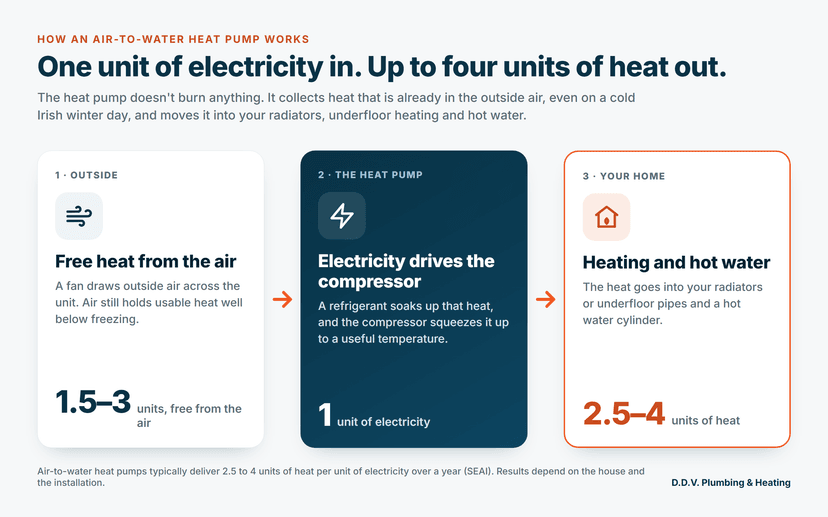
The electricity only drives the compressor and pumps; it isn't turned straight into heat. SEAI puts the electricity a heat pump uses at "usually between 25% and 40% of the heat output", which is where the 250% to 400% efficiency figures come from. Even a modern condensing boiler, by comparison, turns less than 100% of its fuel into heat: SEAI puts condensing boilers at 85% to 97%.
1. Lower running costs than oil, gas or LPG
This is the benefit most people ask about first. SEAI publishes a Domestic Fuel Cost Comparison, and it puts every fuel on the same footing: the cost of one kilowatt-hour (kWh) of heat actually delivered into your home, after the efficiency of the boiler or heat pump.
- Heat pump, night rate4.41c
- Heat pump, standard rate9.82c
- Kerosene oil boiler14.00c
- Natural gas boiler14.45c
- Bulk LPG boiler19.63c
- Electric heaters34.38c
Source: SEAI Domestic Fuel Cost Comparison, edition of 1 July 2026 (oil and LPG prices at 1 July 2026; electricity and gas prices for July to December 2025). Unit rates including VAT; standing charges not included. Heat pump on the standard (Band DD) rate or the night rate at a seasonal performance of 3.5; kerosene at the scheduled price; boilers at 90% efficiency.
On SEAI's figures, a heat pump on a standard electricity rate delivers heat for about 30% less than a modern kerosene boiler at the scheduled oil price, and for about a third of the price on a night rate (which needs a second meter and has its own standing charges). To make that concrete, here is what the same amount of heat costs at those rates. We use 10,000 kWh simply as a round number to compare fuels; your home's real heat demand depends on its size and insulation.
| Heating system | Assumed efficiency | Cost of 10,000 kWh of heat |
|---|---|---|
| Heat pump, standard rate | Seasonal performance 4.0 | €860 |
| Heat pump, standard rate | Seasonal performance 3.5 | €982 |
| Heat pump, standard rate | Seasonal performance 3.0 | €1,146 |
| Kerosene oil boiler | 90% | €1,400 |
| Natural gas boiler | 90% | €1,445 |
| Older kerosene boiler | 80% | €1,575 |
| Bulk LPG boiler | 90% | €1,963 |
Source: SEAI Domestic Fuel Cost Comparison, edition of 1 July 2026 (oil and LPG prices at 1 July 2026; electricity and gas prices for July to December 2025). Unit rates including VAT; standing charges not included. Our arithmetic: 10,000 kWh × SEAI's cost per kWh of heat.
Two honest caveats. First, oil prices swing: SEAI's figures show scheduled kerosene prices fell 33.4% between April and July 2026 but were still 15.6% higher than a year earlier. Electricity prices move too. Second, a heat pump only reaches the better end of that table when it is the right size for the house, set up properly and running into a reasonably well insulated home.
2. SEAI grants of up to €14,500
For a house, the SEAI heat pump grant can be made up of three parts. The figures below are from SEAI's heat pump grant page as of October 2026.
| Grant | House | Apartment |
|---|---|---|
| Air-to-water heat pump | up to €10,500 | |
| Central heating system upgrade | up to €2,000 | |
| Scrapping your old boiler | €2,000 | |
| Most you can get | €14,500 | €11,500 |
| Technical assessment grant (where needed) | €200 | |
| Air-to-air heat pump (no hot water) | up to €9,500 |
Source: SEAI, Heat Pump Systems grant page, checked 16 Oct 2026. The grant can never be more than the cost of the work.
Who qualifies
- Your home must have been built and occupied before 2021, and have an electricity meter number (MPRN).
- Homes built before 2007 need a technical assessment to show they lose heat slowly enough (a Heat Loss Indicator of 2.3 or less), unless a current BER already shows it. Homes built from 2007 don't need one.
- A new BER is done after the work.
- If you are replacing a heat pump that never got a grant, the grant is up to €6,500 (€4,500 for an apartment), without the scrappage or central heating parts.
On top of the grant, since 1 January 2025 the supply and installation of a heat pump system is charged VAT at the reduced rate of 9%, as long as it is supplied and fitted under one contract. Heat pump installations with us start from €14,500, depending on the size of the house and its BER rating, and the SEAI grant can cover a large part of that. See our heat pump installation page to find out more about how we work.
3. Far lower carbon emissions
A heat pump burns nothing in your home, and because it gets several units of heat from each unit of electricity, its emissions per unit of heat are a fraction of any boiler's, even though some of Ireland's electricity still comes from fossil fuels.
- Heat pump57 g
- Direct electric heating198 g
- Natural gas boiler204 g
- LPG boiler246 g
- Kerosene oil boiler275 g
Our calculation from SEAI conversion factors (electricity: 2025 provisional, 197.8 g/kWh). Boilers at 90% efficiency, heat pump at a seasonal performance of 3.5.
On those figures a heat pump produces about 79% less CO₂ per unit of heat than an oil boiler and about 72% less than a gas boiler. The gap should widen if the Government's target of 80% renewable electricity by 2030 is met: renewables supplied 41.3% of Ireland's electricity in 2024, a record. A boiler's emissions stay the same for as long as it runs.
What about carbon tax? It had been due to keep rising, to €78.50 a tonne by 1 May 2027. In Budget 2027 (6 October 2026) the Government said the carbon tax on kerosene and gas will instead be cut from €63.50 to €48.50 a tonne and kept at that rate for the lifetime of the Government. For kerosene the carbon charge works out at about €123 per 1,000 litres (Revenue, rates from 14 October 2026). So carbon tax is no longer a reason in itself to switch soon; running costs, grants and comfort are.
4. Steady, even warmth in every room

A boiler heats in bursts: the house warms up quickly, then cools until the next time the heating comes on. A heat pump works the other way. It runs for longer at a lower water temperature and keeps the whole house at a steady temperature. SEAI describes it as maintaining "a constant, comfortable temperature throughout the year". The aim is a house that stays at a steady temperature rather than starting from cold each morning.
Because the water is cooler, radiators often need to be larger than the ones an old oil boiler used, and the central heating upgrade part of the SEAI grant (up to €2,000) can help with the cost. Heat pumps also suit underfloor heating, which runs at a low water temperature. A heat pump is designed to supply all of your heating and, in SEAI's words, "at least 80% (but usually all)" of your hot water.
5. No oil deliveries, no tank and no flame in the house
If you heat with oil, a heat pump means no more ordering deliveries, watching the gauge in January or finding room for a tank. With LPG it ends the deliveries and the cylinder or tank costs. There is no flue and no fuel stored at the house for the heating.
That also takes away one source of carbon monoxide. The HSE explains that carbon monoxide comes from fuels such as gas, oil, coal and wood that don't burn fully, including in boilers. A heat pump burns no fuel. If you keep a stove, open fire or gas hob, you still need a carbon monoxide alarm.
6. Your BER, and a possible boost to your sale price
Replacing an oil or gas boiler with a heat pump takes fossil fuel out of your heating, and the BER you end up with depends on the whole house, including its insulation; a new BER is done after the work. Since 24 May 2026 new BER certificates use the scale A0, A, B, C, D, E, F and G, with A0 reserved for homes that use no fossil fuels at all. Existing certificates stay valid for ten years.
A better rating also shows up in sale prices. In August 2026 SEAI analysed around 50,000 home sales from 2023 and 2024 and found that each step up the (old, 15-step) BER scale was linked to a higher sale price.
| Where the home is | Higher sale price per BER step |
|---|---|
| Rural areas | 4.7% |
| Nationally | 2.7% |
| Urban areas outside Dublin | 2.7% |
| Urban Dublin | 1.7% |
Source: SEAI analysis of MyHome sale prices, 2023–24, published 17 August 2026. Steps on the BER scale used before May 2026.
7. Long life and simple upkeep
With regular maintenance, a heat pump can last 15 to 20 years or more. A 2020 paper hosted by SEAI gives a usual lifespan of about 15 years, and the Heat Pump Association of Ireland's code of practice says 20 years or more with maintenance. SEAI's operation and maintenance guidance recommends a specialist service once a year, and the refrigerant (F-gas) must be checked annually by a certified contractor.
8. It's where Irish home heating is going
The Government's Climate Action Plan 2024 sets out 680,000 heat pumps by 2030: 400,000 in existing homes and 280,000 in new ones. It describes fossil fuel heating as effectively phased out as the main heating system in new homes. For existing homes there is no ban on oil or gas boilers; the plan is to bring in rules only for major renovations. Fitting a heat pump now puts your home's heating in line with where Irish policy is heading.
The downsides of heat pumps, honestly
A heat pump isn't the right answer for every house. Here is what to weigh up, and what helps.
| The concern | What it means | What helps |
|---|---|---|
| Up-front cost | Much more than a replacement boiler. Installs with us start from €14,500, set by the size of the house and its BER rating. | Grants of up to €14,500 for a house, and 9% VAT. |
| Insulation matters | A leaky house needs a lot of heat, so running costs rise. | A heat loss survey first. Homes built before 2007 need a Heat Loss Indicator of 2.3 or less for the grant. |
| Bigger radiators | Cooler water means some radiators may need to be larger. | Up to €2,000 central heating grant; underfloor heating suits heat pumps well. |
| Cold weather | Efficiency drops when the air is coldest, just when you need most heat. Units also defrost now and then. | Correct sizing for the coldest days, and a low, steady flow temperature. |
| Space and noise | You need room for an outdoor unit and an indoor hot water cylinder. The fan makes some noise. | Careful siting, away from bedroom windows and neighbours. Planning exemptions for heat pumps have come with conditions, including on noise and siting, so check the current rules for your site. |
Sources: SEAI heat pump grant page and Heat Pumps Technology Guide.
Is a heat pump worth it for your home?
For many Irish homes, especially those heated by oil or LPG, the answer can be yes, as long as the house is reasonably well insulated and the system is designed for it. It is most worth it if:
- you heat with oil or LPG today, where the running cost gap is wide, and widest with LPG;
- your home was built and occupied before 2021, the first condition for an SEAI grant;
- the house is reasonably well insulated, or you plan to insulate first;
- you plan to stay in the house for a good few years to enjoy the savings and comfort.
It is less likely to pay off in a very draughty house with no plans to insulate, or where there's no space for the outdoor unit and a hot water cylinder.
How we approach a heat pump install
We are an SEAI registered, RGI heating firm, and heat pumps are most of what we do. We survey the house first, and you get a full written report on your home and how the system should perform, so you know what to expect. Quotes are free and valid for 30 days, and the quote is the price unless something unexpected turns up, which we discuss with you first. Installs are usually 3 to 4 days on site, they usually start 3 to 4 weeks after booking, and all our work comes with a 12-month written warranty, plus a 5-year warranty on the heat pump. We register it for you. It needs a service every year to stay valid.
If you're between Ballsbridge and Wicklow town and want to know whether a heat pump suits your home, get in touch for a free quote or read more about our heat pump installation service.